
Articles
Urban Development
August 11, 2026

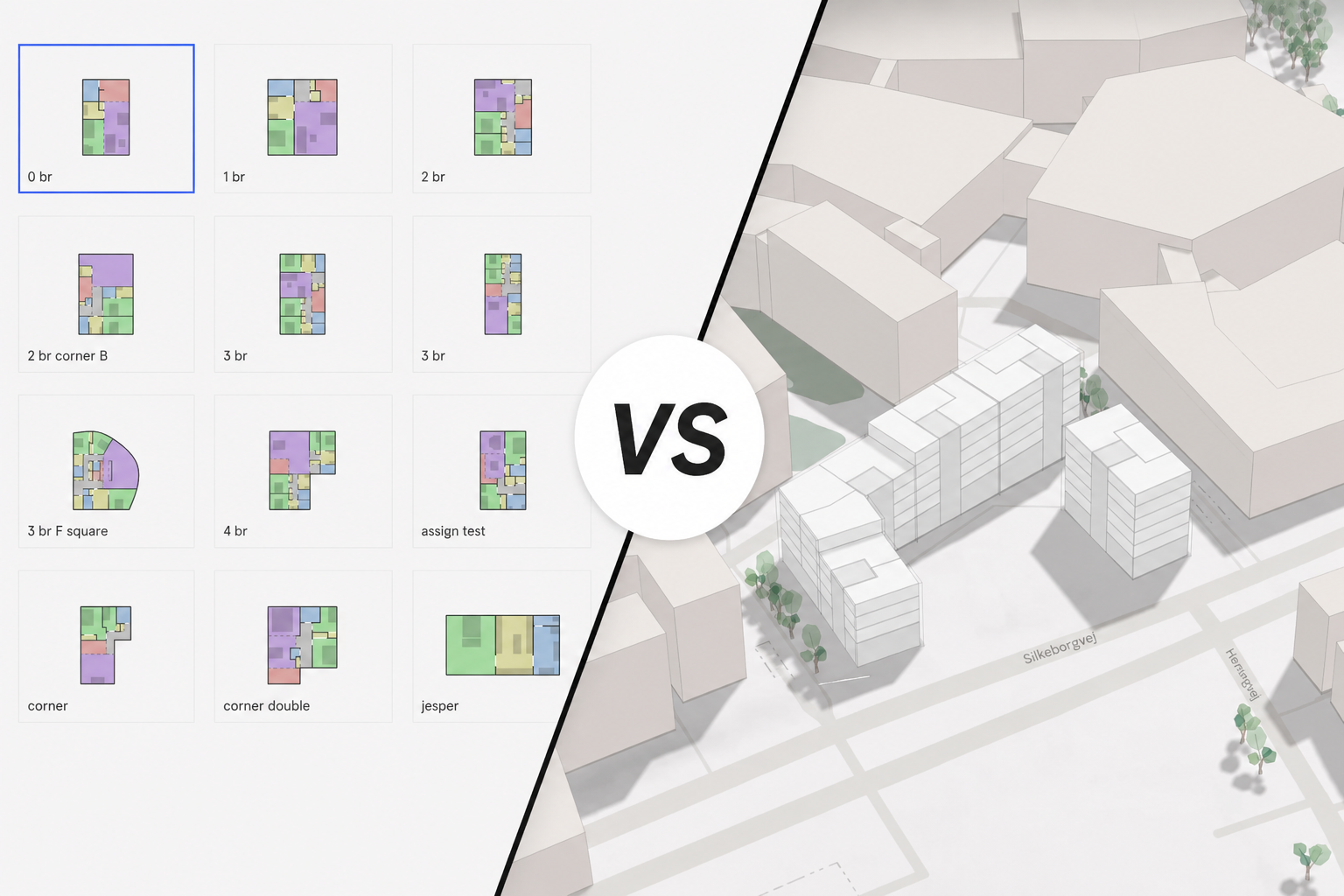

There are not many Swedish-built generative design companies in architecture. There are two. Finch3D, founded in Malmö by three architects with strong Revit ties. Hektar, founded in Stockholm by a different team with strong urban planning ties.
Prospects who hear about one often hear about the other. The instinct is to treat us as direct competitors. That framing is wrong, and we will spend the rest of this post explaining why.
For context: We make Hektar. We know the Finch3D team by reputation and respect their work. The two companies have no formal relationship, but we share a Nordic tech-and-design culture that shapes how both products were built.
Finch3D is a generative floor plan engine. You give it a building massing (typically from Revit or Rhino) and a set of constraints (unit mix, daylight requirements, adjacency rules, firm-specific design standards). Finch produces dozens of compliant floor plan variations in seconds, complete with metrics.
The founders are architects. Pamela Nunez Wallgren, Jesper Wallgren, and Martin Kretz built the product around what they wished existed when they were doing schematic floor plan iteration in practice. The technology is graph-based: rooms become nodes, adjacencies become edges, constraints become rule sets. The Enterprise tier supports custom graph rules so firms can encode their own standards into the AI.
For multi-family residential schematic design, Finch3D is genuinely impressive. The Revit integration is two-way and live. The output is a real BIM model, not a reference image. For firms whose deliverable is Revit and whose bottleneck is floor plan iteration, this is a category-leading tool.
Hektar starts upstream of where Finch3D starts. Finch needs a building massing as input. Hektar produces the building massing as output.
This is a simple but important difference. Consider a developer evaluating a 12-hectare site in Mälaren. The developer doesn't yet know how many buildings will fit, what shapes they should be, what the parcel divisions should look like, or whether the detaljplan even permits the densities the deal requires. None of these questions can be answered by floor plan optimization. They are all upstream of the floor plan.
Hektar's zone tools answer them. The typology library proposes feasible combinations. The generative engine produces parcel arrangements and building configurations. The site-level analyses (Direct Sun Hours, Sky View Factor, road noise) validate the proposals against Nordic compliance standards.
Once Hektar has done its work, you have a chosen scenario with defined building massings. That is exactly where Finch3D's work begins.
Here is the framing we think is correct: Hektar and Finch3D are sequential tools on the same project timeline, not competitive tools fighting for the same workflow slot.
A typical Nordic residential project might look like:
Steps 2 through 4 are where Hektar lives. Steps 5 and 6 are where Finch3D lives. The handoff between the two is conceptually clean, even though the tools do not yet integrate technically.
Finch3D uses a freemium model. Free for manual editing and integrations, but no AI generation. €49 per month for Basic with multi-family residential generation. €1,000 per month for Enterprise, billed annually at €12,000 for three seats, which adds full BIM model output and custom graph rules.
The Basic tier is accessible for individual architects. The Enterprise tier is sold to firms committed to systematic floor plan generation at scale. The jump between them is significant.
Hektar Pro starts at 250 SEK per month, roughly half of Finch Basic at current exchange rates, scaling to 750 SEK and 2,000 SEK. Enterprise is custom. The pricing reflects that Hektar's buyer is often a single architect, planner, or small developer team making feasibility decisions, not necessarily a firm running production floor plan generation.
Both companies offer free tiers that are real, not crippled. Both offer accessible entry pricing. The differences emerge at the top end where each tool's deepest capabilities are sold to different organizational profiles.
Both tools have typology systems, but they operate at different scales.
Finch3D's typology system is interior: unit types, room configurations, circulation patterns. Custom graph rules let firms encode their proprietary unit plans into the AI. The Enterprise tier extends this with detailed unit plan generation.
Hektar's typology system is exterior and urban: five volume types (Point, Lamella, L, U, Quarter) combined with four block plan access types (Corridor, Gallery, Point House, Lamella with staircase in facade). Five hundred plus base parcel configurations. The library operates at the scale of how buildings sit on parcels, how parcels sit in blocks, how blocks fit a site.
If your question is what fits inside a building, Finch's library is the relevant one. If your question is what buildings fit on a parcel and what parcels fit in a block, Hektar's library is. Neither replaces the other.
Finch3D's analyses measure floor plan performance. Daylight at the interior level. Spatial efficiency. Adjacency compliance. The architect specifies the constraints; Finch optimizes within them.
Hektar's analyses measure site and building performance. Direct Sun Hours at the parcel scale, calibrated to Swedish and Norwegian standards. Sky View Factor for outdoor space evaluation. Road noise modeling. Parking norm validation. Area calculations following Boverket.
Once again: not competing analyses, but adjacent ones at different scales of the same project.
This is Finch3D's strongest argument and a clear gap in Hektar's current capability.
Finch maintains a live two-way connection with Revit 2023 and 2024. Changes in Revit update the Finch model. Optimized layouts generated in Finch export back as full BIM models with walls, doors, area tags, and space labels. For firms whose entire delivery chain runs through Revit, this matters enormously.
Hektar exports to Rhinoceros (.3dm), generic OBJ, and Excel. The handoff is one-way and not BIM-grade. For Rhino-centric European practices, this is sufficient. For Revit-centric firms, Finch's BIM integration is decisively better and we do not pretend otherwise.
Finch3D does not emphasize geodata. The platform expects a massing as input; the site context is the architect's responsibility. There is no detaljplan layer, no Lantmäteriet integration, no automatic parcel boundary ingestion. This is not a weakness; it is a deliberate scope choice.
Hektar integrates directly with Lantmäteriet, BAG, AHN, and equivalent Nordic data sources. Parcel boundaries, ownership data, regulatory layers, building footprints all come automatically. This is what lets Hektar answer the upstream feasibility question that Finch is not built for.
Finch3D fits architecture firms whose bottleneck is schematic floor plan iteration on existing massings, particularly in multi-family residential, with Revit as the delivery format. If that describes your firm, the value proposition is clear.
Hektar fits architects, planners, and developers whose bottleneck is figuring out what to build at all on raw land in the Nordics, with regulatory compliance and site-level analysis as the key constraints. If that describes your work, we are the better choice.
Many serious Nordic firms will find both tools useful at different points in the same project. The category is not winner-take-all.
Sweden has unusually strong infrastructure for computational design at the intersection of architecture and tech. KTH and Chalmers produce people with both design training and programming skills. There is an investor base that understands AEC tech. The Swedish design tradition values systematic thinking. None of this is coincidence.
No. Floor plan generation is the focus. Site analysis, regulatory validation, parcel configuration - these are outside Finch's current scope.
Technically possible, but we have no announced partnership. The conceptual handoff is clean: Hektar produces feasibility scenarios with defined massings, Finch takes those massings and generates floor plans. A direct export from Hektar to Finch is the kind of thing that would make sense for serious Nordic users.
Both have been in market for several years. Finch3D's depth in floor plan generation is more developed than Hektar's. Hektar's depth in regulatory and geodata integration is more developed than Finch3D's. Each is mature in its primary domain.
The honest take: we are not really competitors. We are tools that solve adjacent problems for an overlapping audience. The most sophisticated Nordic teams will use both.
If you are choosing between us because your budget supports one and not the other, the deciding question is which bottleneck dominates your current workflow. If you are stuck generating floor plans, pick Finch3D. If you are stuck figuring out what is buildable, pick Hektar. The answer is rarely ambiguous once you ask the question clearly.
For more comparisons, see Hektar vs Forma, Hektar vs Giraffe, Hektar vs TestFit, or the full market overview.
