
Articles
Urban Development
August 11, 2026
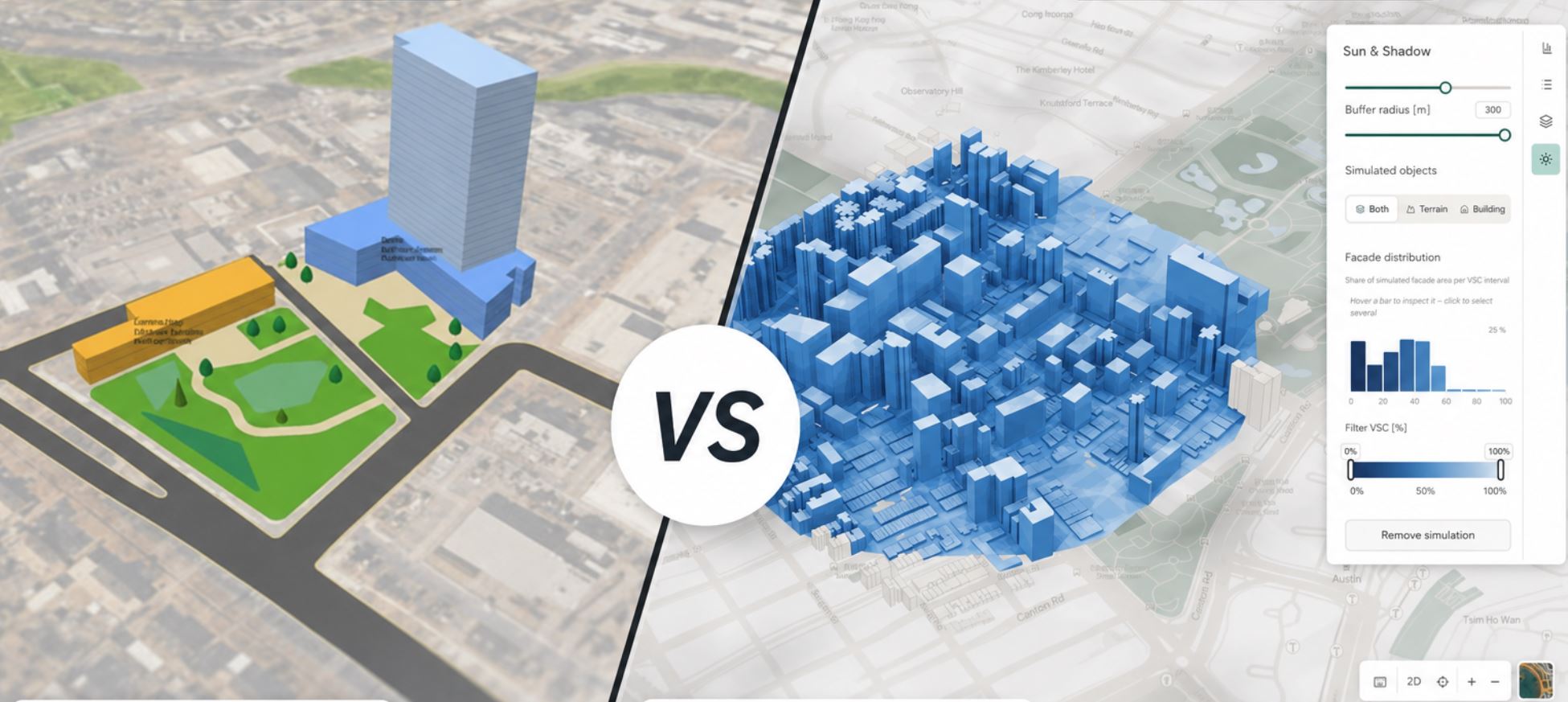

Imagine a developer sitting down on a Monday morning with a new site. The seller wants an answer by Friday. There is roughly $40 million on the table if the numbers work, zero if they don't. The developer opens her laptop, pulls up the parcel, and starts building a model.
What that model looks like depends on which tool she opens. If she opens Giraffe, the first thing she sees is the pro-forma updating in real time as she sketches massing. If she opens Hektar, the first thing she sees is a generative engine producing feasible block configurations against the local detaljplan.
Both tools answer her question. They just answer different parts of it first. This post is about which part of the question matters more for which kind of buyer.
Disclosure: We make Hektar. We respect Giraffe and what the team there has built. The comparison below is honest about where they win and where we win.
Giraffe was founded in Sydney in 2017, with the explicit ambition of being the orchestration layer for AI-driven real estate decisions. Not just a design tool. Not just an analysis tool. A platform where spatial data, financial modeling, and design intent all converge in a single browser window.
The company has done thousands of projects. Billions of dollars in development decisions have passed through their software. The Sydney HQ now has US offices in Florida and Philadelphia, and the customer base is global, with strongest density in English-speaking markets.
What Giraffe is genuinely best at, in our view, is collaboration on the pro-forma. Developers, architects, planners, and consultants can sit in the same model and watch the financials update as design decisions change. That is technically hard and operationally rare. It is Giraffe's strongest argument and one we do not match.
Hektar centers a different actor in the workflow. Where Giraffe optimizes for the developer who needs to see financial impact instantly, Hektar optimizes for the architect or planner who needs to know what is buildable before financial impact even becomes a meaningful question.
The reason is structural. In the Nordics, raw land projects pass through detaljplaner, kommuneplaner, and equivalent regulatory layers. The earliest question is not, "What yields the best return?" It is, "What does the regulation allow here at all?" The pro-forma comes later, after the feasible solution space is established.
This is why Hektar's first move is generative configuration against regulations, not pro-forma simulation. The typology library and zone tools are the heart of the workflow. The financial outputs that follow are derived from the regulatory feasibility, not the other way around.
Giraffe uses a four-tier model. Free for one project, $1,000 per user per year for Core, $3,000 per user per year for Portfolio, and custom Enterprise pricing for organizations needing SSO and API depth. (These numbers were published in 2023 and may have moved. Check with Giraffe directly.) The pricing makes Giraffe accessible at the individual level but signals enterprise sales at scale.
Hektar Pro starts at 250 SEK per month, with 750 SEK and 2,000 SEK tiers above. Converted at typical rates, the entry tier sits at roughly a third of Giraffe Core, and it is positioned for single architects and small municipal teams who would not get budget approval for a $1,000 annual seat.
This pricing gap is not about cost structure. It is about who each tool is built to be bought by. Giraffe's pricing assumes a developer organization writing real checks. Hektar's pricing assumes that the buyer is often one or two people deciding without involving procurement.
One way the tools differ visibly: Giraffe gives you generative drawing tools with detailed control over geometry, including mullions and roof structure. The architect builds the massing manually. Giraffe handles the data layer around it.
Hektar gives you a library: five volume typologies, four block plan access types, more than 500 base parcel configurations. The platform proposes the massing; the architect refines or rejects it. This is the more opinionated approach. It compresses iteration time at the cost of bespoke geometric control.
Neither approach is better in the abstract. Bespoke design work benefits from Giraffe's flexibility. Exploratory feasibility work benefits from Hektar's library. Choose the metaphor that matches your dominant workflow.
Giraffe's strongest analytical argument is the pro-forma. Site analysis layers including parcel, tax, and zoning data live alongside wind and solar facade impact, carbon emissions quantification, and the financial model. The integration of design, environment, and economics into a single live model is real and well-executed.
Hektar's analytical stack is narrower and tuned to Nordic regulatory compliance. Direct Sun Hours follows Swedish and Norwegian conventions. Sky View Factor at parcel level. Road noise modeling. Parking norms integrated by jurisdiction. Area calculations matched to Boverket standards.
For a developer who needs the financial model to evolve with the design in real time, Giraffe is hard to beat. For an architect or planner who needs regulatory compliance validated before financial modeling becomes meaningful, Hektar's analyses map more directly to the actual decisions.
Comparison content rarely engages honestly with geography, but it matters more than most other dimensions.
Giraffe is built for English-language markets globally. Australia, US, UK, Canada. The data integrations and regulatory framing reflect those contexts. The platform can be used anywhere, but its native fluency is highest in those markets.
Hektar is built for Sweden, Norway, Denmark, and the Netherlands. Direct Lantmäteriet integration. Live BAG and AHN data for Dutch projects. Detaljplaner and kommuneplaner as first-class regulatory layers, not generic zoning approximations.
For a Stockholm or Copenhagen developer, this matters. For a Sydney or Houston developer, Giraffe's data depth is far better than ours.
If your workflow requires sitting in a live model with a client during feasibility, Giraffe is built for that. The shared-model approach is more mature than Hektar's. Multiple stakeholders can co-author in real time, with the pro-forma updating for all of them simultaneously.
Hektar supports project sharing and team collaboration, but the workflow is closer to traditional design review than to live co-authoring during a client meeting. If real-time multi-party collaboration is your bottleneck, Giraffe wins this comparison clearly.
Giraffe is the right tool when:
Hektar is the right tool when:
Not natively. Giraffe can ingest external regulatory data, but it does not have direct connections to Swedish or Norwegian regulatory layers the way Hektar does. For Nordic projects where these layers matter, this is a meaningful gap.
Yes, and it is not close. Giraffe's pro-forma integration is a core product capability with years of investment. Hektar's financial outputs are limited to areas, unit counts, and basic yield calculations. If financial modeling is decisive, Giraffe is the better tool today.
In Nordic markets, Hektar gets more municipal uptake because the regulatory integration matches how Nordic planning departments work. Globally, Giraffe has stronger municipal presence because the data orchestration model fits English-speaking planning workflows.
Yes. A reasonable workflow uses Hektar for the early regulatory and typology feasibility, then Giraffe for the financial modeling and stakeholder collaboration phase once a scenario is chosen. The two tools live at adjacent points on the same timeline.
The Giraffe pricing figures here come from 2023 sources and may have changed. Verify directly with Giraffe. The Hektar pricing reflects current rates as of 2026. We will update this comparison when one of us moves significantly.
The Giraffe team has built something genuinely impressive over eight years. The pro-forma integration alone is a category-defining capability. We are not competing for the same buyer in the same market in most cases. When the buyer is Nordic and the decision is regulatory, we believe Hektar wins. When the buyer is global and the decision is financial, Giraffe wins. Both can be true.
For more comparisons, see Hektar vs Forma, Hektar vs Finch3D, Hektar vs TestFit, or the full market overview.
