
Articles
Urban Development
August 11, 2026

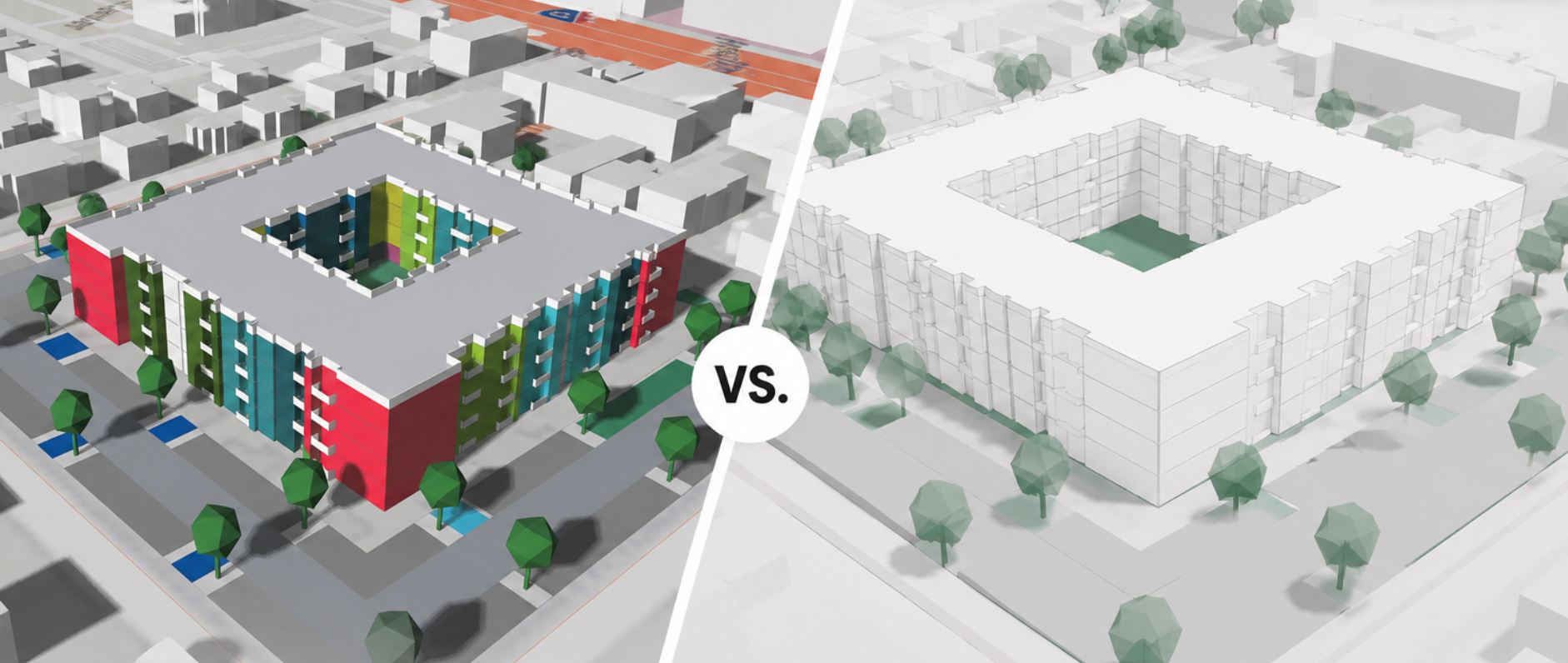

In Dallas, a real estate developer evaluating a 4-acre site asks: how many units can I fit, how many parking stalls do zoning rules require, and what is the yield on cost? In Stockholm, a real estate developer evaluating a 2-hectare parcel asks: what does the detaljplan permit, what parking norm applies, and which typology fits the noise context?
These are the same kind of question dressed in different regulatory wardrobes. TestFit is the American answer. Hektar is the European one. The differences between the tools are real and they reflect deeper differences between how real estate development actually works on each side of the Atlantic.
Disclosure note: We build Hektar. We respect TestFit's work and consider them peers, not adversaries. The comparison below tries to be honest about what each side does well.
TestFit was founded in Dallas. The company has raised $22 million and works with US architecture firms like Ware Malcomb and AC Martin, plus regional firms like Motif Architects and RBA Architects, and a growing list of US-based developers and contractors.
The product has three modules. Urban Planner provides pre-zoning analysis. Data Maps adds zoning and environmental data. Site Solver provides full generative design and detailed typology solutions, with parking optimization, yield-on-cost calculations, and automatic cut and fill as core features. Generative design is exclusive to the top tier.
The customer outcomes TestFit reports are concrete and substantial. AC Martin generated 4x more design options during early phases. Motif Architects compressed analyses from longer timeframes into three weeks. These are real productivity gains in a market where time-to-decision affects deal flow directly.
What TestFit is best at, in our view, is rapid feasibility across a wide range of building types within US regulatory conventions. The platform supports eight typologies including industrial, retail, hotels, parking structures, and data centers alongside the residential cases. No other tool in the category matches that breadth.
Hektar started from a different observation about a different market. In Sweden, Norway, Denmark, and the Netherlands, the feasibility question has different structure. Yes, density matters. Yes, financial returns matter. But the first-order constraint is regulatory: the detaljplan, the kommuneplan, the equivalent national zoning instruments. Until those are satisfied, no amount of financial modeling produces actionable answers.
This is not a value judgment about which framework is better. American zoning is often more permissive at the building-type level (you can typically build a wider range of uses) but more restrictive at the parking and bulk level. European zoning is often more restrictive at the use level (detaljplaner can specify residential character with great precision) but more flexible at the typology-within-residential level.
Hektar's zone tools and typology library are calibrated to this European structure. The Direct Sun Hours analyses follow Swedish and Norwegian conventions. The parking norm validation reflects Nordic municipal practice. The area calculations match Boverket. None of this is decoration; it is the substance of what feasibility means in this market.
If you are doing parking structures, data centers, hotels, industrial facilities, or single-family subdivisions, TestFit has you covered. The platform's typology range is the widest in the category and the presets encode US industry practice.
Hektar does not. We focus on residential because Nordic raw land development is overwhelmingly residential in volume. Our typology library covers five volume types (Point, Lamella, L, U, Quarter) combined with four block plan access types (Corridor, Gallery, Point House, Lamella with staircase in facade), producing more than 500 base parcel configurations within that residential domain.
This is a deliberate choice. We would rather be excellent at residential feasibility in our home markets than mediocre at everything everywhere. TestFit made a different choice, and theirs is the right choice for the US market they serve.
TestFit does not publish pricing publicly. The product is sold through demo and sales conversation. Site Solver subscribers get a dedicated account manager. Volume discounts are available for larger deployments. This is enterprise-style sales.
This pricing posture fits the US development industry. The buyers are architecture firms and developer organizations with budget and procurement processes. Selling per-seat SaaS to such buyers without a conversation is rarely how the deals close.
Hektar Pro publishes its tiers openly: 250 SEK per month for 50 credits, 750 SEK for 200 credits, 2,000 SEK for 1,000 credits. The starting tier is designed for individual architects and small municipal teams who would never get past a procurement gate for an enterprise contract. We made this choice because the European market includes a long tail of single-practitioner architects and small developer teams that the American enterprise model does not serve.
One under-discussed dimension: TestFit and Hektar use the phrase "early-stage" to mean different things.
For TestFit, early-stage often means after a site is identified and the developer is doing rapid go/no-go evaluation. The platform's strengths (parking optimization, yield-on-cost, building type comparison) are most useful when the deal is on the table and the question is whether to pursue it.
For Hektar, early-stage often means before a site is fully understood. The platform's strengths (regulatory feasibility, typology generation, parcel configuration) are most useful when the question is what the site can become at all.
The TestFit early-stage is a couple of weeks. The Hektar early-stage is the same couple of weeks plus the months of regulatory and typology exploration that precede them.
TestFit integrates with Revit, SketchUp, and AutoCAD. American architects work predominantly in Revit, and TestFit reflects that. No public API. The handoff is designed for standard US delivery workflows.
Hektar exports to Rhinoceros (.3dm), generic OBJ, and Excel via the export scenario workflow. European architects work more often in Rhino than American architects do, and Hektar reflects that. Same logic, different default.
Both choices are correct for their primary markets. Neither is universal.
TestFit's data integration is strongest in the US. Zoning data through the Data Maps tier. Parcel selection. Customizable road layout. Turning radius and 3D terrain. The coverage and depth in US markets reflects the home-market focus.
Hektar's data integration is strongest in Sweden, Norway, Denmark, and the Netherlands. Lantmäteriet, BAG, AHN, and equivalent Nordic sources are first-class layers. Parcel boundaries, ownership data, detaljplaner and kommuneplaner as live regulatory layers, building footprints with high fidelity.
Outside their primary geographies, both tools become less useful. TestFit in Europe approximates regulatory framing in ways that create friction. Hektar in the US lacks the native zoning depth that TestFit has invested in. The data layer is the most decisive geographic differentiator.
TestFit is the right answer for US-based developers, architects, and contractors working on a wide range of building types, particularly multi-family residential, industrial, retail, hotels, parking, and data center projects. The yield-on-cost and parking optimization are decisive for US feasibility decisions and we do not match them.
Hektar is the right answer for Nordic and Northern European architects, developers, and municipal planners working primarily on residential raw land where regulatory compliance and Nordic geodata integration are the decisive constraints. For the European feasibility question we are built for, we believe Hektar is the better tool.
Technically yes, but the regulatory framing creates friction. TestFit's presets reflect US norms for parking ratios, zoning structures, and yield-on-cost. For Swedish detaljplan work, the framing fights you. Practical for some use cases, suboptimal for most.
Same answer in reverse. Hektar is calibrated to European regulatory contexts and Nordic geodata. For Texas zoning, parking optimization, and US construction economics, TestFit's native depth is significantly better than ours.
TestFit, by a clear margin. Eight typologies versus our residential focus. If your work spans many building types, the breadth is meaningful and we cannot match it.
It is a deliberate signal. The product is sold to firms with budget and procurement processes, not to individual architects shopping for monthly SaaS. The pricing structure follows the sales model.
Limited. The Atlantic is a meaningful product boundary. Some Nordic developers with US operations use both. Some US developers expanding into Northern Europe try Hektar. But the modal customer for each tool is firmly in its home market.
TestFit and Hektar are two genuinely strong tools serving two genuinely different markets. We respect what TestFit has built, particularly the typology range and the US regulatory depth. They almost certainly respect what we have built in our home markets, even if they do not say so publicly.
The category will be large enough for both companies for the foreseeable future. The differentiation is real and the buyers benefit from having serious tools in each regional context.
For more comparisons, see Hektar vs Forma, Hektar vs Giraffe, Hektar vs Finch3D, or the full market overview.
